Summit County residents who need mental health care have several distinct entry points, and the right one depends on the situation: a crisis, an overwhelming search for the right therapist, or a cost barrier that makes therapy feel out of reach. For most non-emergency needs, Building Hope Summit County serves as the central connector. Its Care Team provides free mental health navigation by phone or email, and the organization runs a therapy scholarship for locals who live or work in the county and cannot afford treatment. For immediate emergencies, the 988 crisis line operates around the clock, and for residents needing integrated behavioral and primary care, Mile High Integrated Care in Frisco offers a full continuum of services that accepts Building Hope Scholarships.
Summit County Mental Health Resource Comparison
The table below organizes the county's key resources by the need they serve, the population they target, and how financial help is accessed. It is designed to let a reader match a specific situation—such as "I need help finding an affordable therapist" or "I'm a senior who doesn't know where to start"—to the correct first point of contact.
| Service/Organization | Best For (Need) | Target Population | How to Access Financial Help |
|---|---|---|---|
| Building Hope Summit County | Guidance on available resources and treatment options; financial aid for therapy | Summit County residents, including those experiencing financial hardship | Call the Care Team (970-485-6271) to discuss needs and confirm scholarship eligibility; other payment options are checked first |
| Mile High Integrated Care (MHBHC), Frisco | Integrated behavioral and primary healthcare, substance use support, case management, peer support | Individuals on a recovery journey from trauma, substance use, mental health challenges, and housing instability | Accepts Colorado Medicaid, Cigna, and Aetna, plus Building Hope Scholarships and a sliding fee scale; scholarships are arranged through Building Hope's Care Team |
| 50+ Care Navigation | Help accessing community resources and determining eligibility for public benefits | Low-income seniors age 50 and over | Services are free; contact Roger Abdella at Summit County to schedule an appointment |
| Colorado Crisis Services / 988 | Immediate crisis support, available 24/7 with bilingual services | Anyone experiencing a mental health or self-defined behavioral health crisis | Crisis support is the access point itself; no financial screening is required to call |
| Summit County Walk-In Crisis Center, Frisco | Walk-in support during a behavioral health crisis, including withdrawal management | Anyone experiencing a self-defined behavioral health crisis | Walk-in access at 360 Peak One Drive, Suite 120, Frisco |
Two clarifications help in reading this matrix. Mile High Behavioral Health Care is listed by Building Hope as a Building Hope Scholarship Provider, but the scholarship itself is issued through Building Hope's process, not applied for at the clinic. And while the table covers the county's principal starting points, it is not a directory of every therapist or program; residents with specialized needs can use navigation services to find options beyond it.
Understanding Mental Health Navigation Services
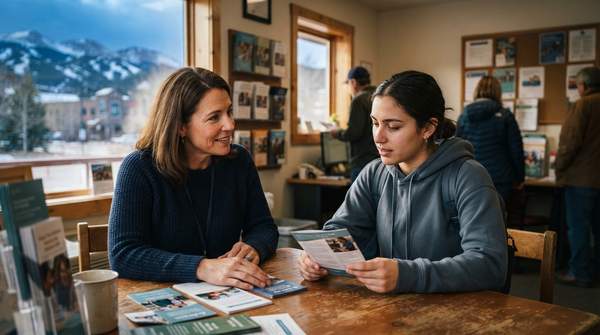
Navigation is the county's answer to a common problem: a resident knows they need help but faces a confusing landscape of providers, insurance rules, and program requirements. Building Hope describes its Care Team as providing mental health navigation services that help Summit County residents find and connect with the mental health treatment options, financial assistance, and local resources that fit their situation. In practice, the navigator does the sorting work—learning what a caller needs and identifying which local services match.
Building Hope frames this as part of a community-wide initiative to create a more coordinated, effective, and responsive mental health system that promotes emotional health, reduces stigma, and improves access to care for everyone in Summit County. Getting started is deliberately low-barrier: residents can call 970-485-6271 or email info@buildinghopesummit.org, asking for mental health navigation services, to be connected with a Care Team member. There is no eligibility gate described for navigation itself, which makes it a suitable first call for people who are unsure whether their situation qualifies for anything.
Navigation is not limited to one age group. For older residents, 50+ Care Navigation offers free services for low-income seniors age 50 and over, assisting individuals and families with access to community resources and with determining eligibility for public benefits. Appointments are scheduled through Summit County. A senior who needs help finding an affordable therapist, for example, could use either service, though the senior program adds expertise in public benefits that a general navigator may not specialize in.
Accessing Financial Assistance for Therapy: The Building Hope Scholarship
Building Hope states plainly that cost is often one of the biggest barriers to accessing mental health care, and its scholarship program is built to remove it. The program serves Summit County locals who are living or working in the county but are not able to pay for therapy. Individuals, families, or couples can receive short-term, one-time funding to access therapy through what the organization describes as an easy-to-use system.
The eligibility criteria are straightforward. An applicant must either live or work in Summit County and be experiencing financial hardship that prevents them from affording mental health care. Notably, Building Hope does not ask scholarship recipients to submit any financial documentation. Instead, recipients give a verbal confirmation that they cannot pay for therapy on their own and that paying for it would present a significant financial challenge.
There is one procedural requirement that shapes the application. Building Hope is required to check whether clients have any other way to pay for therapy—insurance, Medicaid, an employee assistance program, sliding scales, or eligibility for other financial assistance—before issuing a scholarship. Once staff have explored all other payment options with the client and determined that barriers to accessing care remain, a Building Hope Scholarship is issued. In practical terms, this means a caller should expect to discuss their insurance status and other payment options on the call, and should not be discouraged when the Care Team works through those alternatives first; that screening is a required step, not a rejection.
For residents who prefer a specific provider, the scholarship travels with them to participating practices. Mile High Behavioral Health Care in Frisco, for instance, is identified as a Building Hope Scholarship Provider and also accepts Colorado Medicaid, Cigna, and Aetna along with a sliding fee scale, which means a resident could compare payment routes at the same clinic. The scholarship's coverage is bounded, though: it is short-term, one-time funding rather than ongoing support, so recipients should plan for what happens after the funded period ends.
Additional Support and Crisis Resources
When the need is immediate, the entry point changes. The 988 crisis line is available 24/7 with bilingual services, according to Building Hope's resource guide. For in-person help, the Summit County Walk-In Crisis Center at 360 Peak One Drive, Suite 120, in Frisco is described as a safe place for anyone experiencing a self-defined behavioral health crisis, with services to support individuals experiencing withdrawal from substance use. The phrase "self-defined" matters: the person in crisis decides whether they are in crisis, rather than having to meet a clinical threshold to walk in.
Residents coping with substance use or co-occurring conditions have a dedicated option in Mile High Integrated Care, which operates through a partnership with Summit Wellness Hub and Front Range Clinic. The program supports individuals on their recovery journey—from trauma, substance use and mental health challenges, and housing instability—with nurse practitioners trained in addiction treatment providing Medication Assisted Treatment and primary care under a board-certified addiction physician. MHBHC's broader service list includes individual, couples/family, and group therapy, intensive case management, and peer support from trained specialists with lived experience. Case managers there can also connect clients to community resources such as childcare, food, transportation, housing supports, and health insurance.
One limitation applies throughout this guide: it draws on publicly available program descriptions, which may not cover every individual circumstance, and it does not review or rank the quality of care any provider delivers. It is also not medical advice. Residents with clinical questions should raise them directly with a provider or navigator.
Taking the Next Step: Accessing Support
For most Summit County residents who are not in immediate danger, the practical decision is to contact Building Hope's Care Team as a first step—by calling 970-485-6271 or emailing info@buildinghopesummit.org and asking for mental health navigation services—either for help sorting through options or to explore financial aid such as the therapy scholarship. The measurable indicator of success is simple: a resident successfully connects with the Building Hope Care Team or initiates a scholarship application. In a crisis, that step is replaced by calling 988 or walking into the Frisco crisis center, where help is available around the clock.