
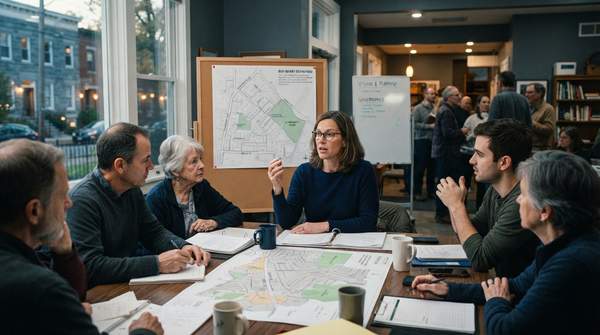
Forming a neighborhood association comes down to four foundational choices: defining the group's purpose, setting its boundaries, choosing a governance model, and understanding how a voluntary association differs from a mandatory Homeowner's Association. Municipal guides from Jackson, Tulsa, Southfield, Albuquerque, and Edina converge on the same sequence—residents gather, a steering committee forms, and the group registers with its city—though the specific requirements vary by municipality. This guide organizes that process into a decision framework rather than a simple checklist, so founders can match structure to goals before launching.
Foundational Decisions for Your Neighborhood Association
The Jackson Association of Neighborhoods recommends starting with a positive attitude and an open mind, then forming a steering committee: an initial group of neighbors interested in neighborhood involvement. That committee establishes the association's purpose—which may change as more residents join—agrees on ground rules for meetings, and determines the neighborhood's boundaries. The Tulsa Planning Office adds a consensus step: discuss with neighbors to confirm there is genuine agreement to form a recognized association and to develop common goals. Tulsa also advises checking the city's map of registered neighborhoods to see whether surrounding areas have already organized and established boundaries, which helps avoid overlapping claims.


